
The tech helping us teach a time-honoured trade

We’ve embraced some cutting-edge technology to help us train students in one of the most traditional of trades – welding.

Our virtual welder machine helps new learners get used to welding techniques, risk-free and without the need for protective gear, before they try the real thing.

Teachers are also finding that the equipment, which gives users a score based on their performance, is a useful way of adding some lighthearted competition to classes.

And, by saving on materials, it offers sustainability benefits too.

A valuable teaching tool

Welding and Fabrication Course Leader, Simon Davison (pictured), said: “The Lincoln Electric Vrtex 360 virtual welder we use is pretty good for developing initial hand – eye coordination, and for practising travel speed, angle and torch distance away from the weld.

“The visuals are good, the sound is realistic and the choice of different work zones is cool.

“We can operate virtually in a typical welding bay, a large top-end auto shop, a military desert base or even a nuclear power plant. All the scenes and backdrops simulate real working environments.”

Adding fun and a hazard-free experience
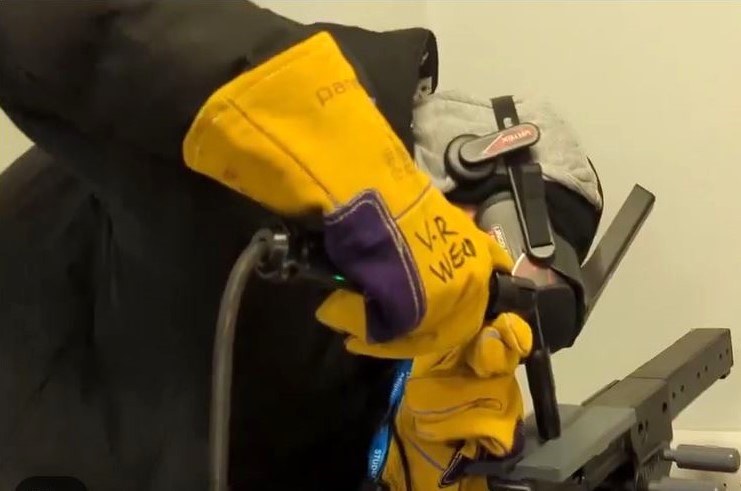
The equipment, purchased a few years ago with government Levelling Up funding, is also a useful aid for logging students’ efforts and ranking them according to factors like travel speed, angle, and weld quality.

Each user is given a score and can replay a recording of their welding work to see what they did well, and where they could improve.

Simon said: “Overall it is a very good piece of kit and adds fun and provides a hands-on experience whilst eliminating all of the potential hazards or dangers of real welding.”

The human factor

As great as the virtual reality (VR) machine is though, particularly for beginner welders, it does have its limitations.

Simon said: “It is a good ice breaker and is popular with brand new welding students but once they get a taste for real welding there is no substitute for the real thing, as the temperature whilst welding cannot be simulated.

“And a real welding machine will always operate even when your parameters and settings are incorrect, though you’ll get a few weld defects or sparks. With the VR machine, unless you have set it up by the book, it will not work whatsoever so setting it up can be quite tricky.

“Other than that, it’s a great way to save money on metal and a good way to establish a positive relationship, with a fun competitive element, in class.”

A video of Simon demonstrating the virtual welder in action can be viewed here.

Aim high with welding

Keighley College offers a range of enterprising welding courses, ranging from apprenticeships to diplomas.

To find out more about the courses, we spoke with course leader Simon Davison.

What welding opportunities are available at the college?

We begin the offering at Level 1 which teaches the basics of welding, right up to Level 3. Apprenticeships are also really popular here, which typically involves learning technical processes and developing practical skills.

What feedback do you get from students?

They love it. We have outstanding attendance across all our courses; it’s fantastic to see so many students excited about coming into college. We have a really nice mixture of male and female students on the courses. We’ve been so proud to see them go on to some amazing jobs, including working in the oil industry and travelling around the world.

What are the key benefits students can take away?

The students can develop their practical skills of using machinery through regular use of our facilities. We are one of few colleges that gives students their own welding bay, which creates a personalised experience, allowing them to master techniques much quicker than if they were sharing.

Due to us having 15 bays in the workshop, we usually have the same number of students per class. This is a great class size which creates a safe environment and good contact time.

The knowledge students gain from our staff is brilliant. All together, we have around 150 years’ experience and come from a variety of interesting backgrounds including teachers, facilitators and inspectors for the Welding Institute.

Why Keighley College?

Keighley College has an incredibly strong reputation in this field, we have been established as an engineering college for over 100 years and are recognised across the region for our engineering disciplines.

It’s one of the strongest colleges in the North of England for welding – we have an impressive range of equipment and many qualified staff members. The apprenticeship programmes we deliver are especially high quality due to our staff being qualified welding inspectors; we champion perfected techniques and excellent quality.

What advice would you give to a student considering studying a welding course at the college?

I would advise them to come over and meet us, we can give them a tour of the workshop and give some insight into what we do. We’ll let students have a taster and try it for themselves. If it is something they’re interested in, we will give them the best route possible to get on board – whether that is an evening class, full-time course or apprenticeship, we will be able to accommodate them.

Take a look at Keighley College welding courses here.